
Search “steel fabrication near me” and most of what comes back is job shops: a few bays, a plasma table, a paint corner out back. Useful shops, but built for parts, not projects. Then there’s the other end of the scale. LMC Industrial Contractors runs a 700,000+ square foot covered fabrication facility on 88 acres in Dansville, New York, with 55 acres of laydown and storage alongside it.
What actually happens inside a campus that size? This post is the plant tour in writing: what the shop does, how shop fabrication compares with field erection, and why covered capacity has quietly become schedule insurance for fast-track industrial work. If you’re an owner’s rep comparing steel and pipe fabrication companies, start here.
Key Takeaways
- LMC’s Dansville, NY campus offers 700,000+ sq ft of covered fabrication space on 88 acres, plus 55 acres of laydown and storage.
- Shop fabrication trades transport limits for weather control, automated welding, weld-by-weld documentation, and parallel workflows.
- In Northeast winters, indoor fabrication keeps producing while field welding and coating wait on weather windows.
- With US data center construction running at a $50.7B annual pace (US Census Bureau), fabrication capacity now decides schedules.
What Happens Inside a 700,000 Square Foot Fabrication Campus?
Three things, mostly: cutting and welding steel and pipe, blasting and coating it, and staging it so trucks leave in the right order. The Dansville campus puts all of that under one roof and on one property, run by a share of LMC’s 350+ skilled tradespeople and supported by 300+ pieces of owned equipment.
That last part matters more than it sounds. When the fabricator owns its cranes, telehandlers, and haul trucks, material moves on the project’s timeline, not a rental counter’s.
Automated Fabrication and Welding
The shop pairs certified welders and fabricators with automated fabrication and welding equipment. Automation doesn’t replace the welder. It handles the long, repetitive passes at consistent parameters while certified hands manage fit-up, technique, and everything a machine can’t judge. The result is structural fabrication and pipe work produced at steady quality, shift after shift, regardless of what the sky is doing.
Fixed workstations bring a second advantage: inspection lives where the work lives. Welds get checked and documented at the station, in sequence, instead of chased across a jobsite.
NACE Paint and Blast Capability
Bare steel doesn’t stay bare long in the Northeast. Road salt and freeze-thaw cycles see to that. LMC’s NACE-certified painters and blasters prep and coat fabricated steel in controlled shop conditions, where surface preparation, temperature, humidity, and cure times can actually be held to specification. Field touch-up will always exist. Full coating systems belong indoors.
55 Acres of Laydown and Storage
Fabrication capacity means little if finished assemblies have nowhere to go. The 55 acres of laydown and storage let completed steel, spools, and modules stage in delivery sequence, so a project can call for material the week it’s needed instead of warehousing it on a congested site. For fast-track owners, that yard works like a buffer between shop output and field readiness.
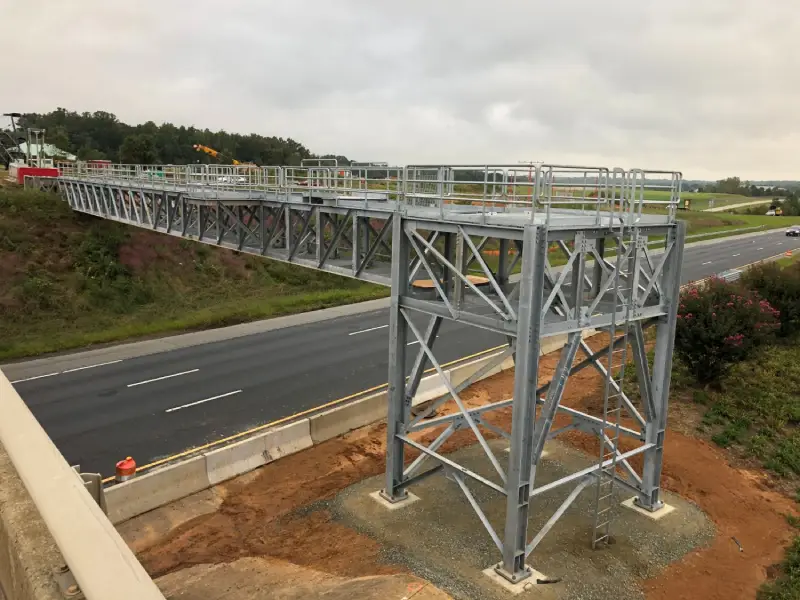
Proof beats floor space, though. The same campus stands behind projects like the Keuka Pedestrian Bridge and the I-85 sign gantries in Davidson County, North Carolina: shop-built steel, shipped and erected in the field, in the gantries’ case hundreds of miles from the shop.
Scoping a fabrication package? LMC quotes structural steel, pipe, and coatings work from one campus in Dansville, NY. Contact us or call (585) 335-3131.
Shop Fabrication vs Field Erection: What Are the Trade-Offs?
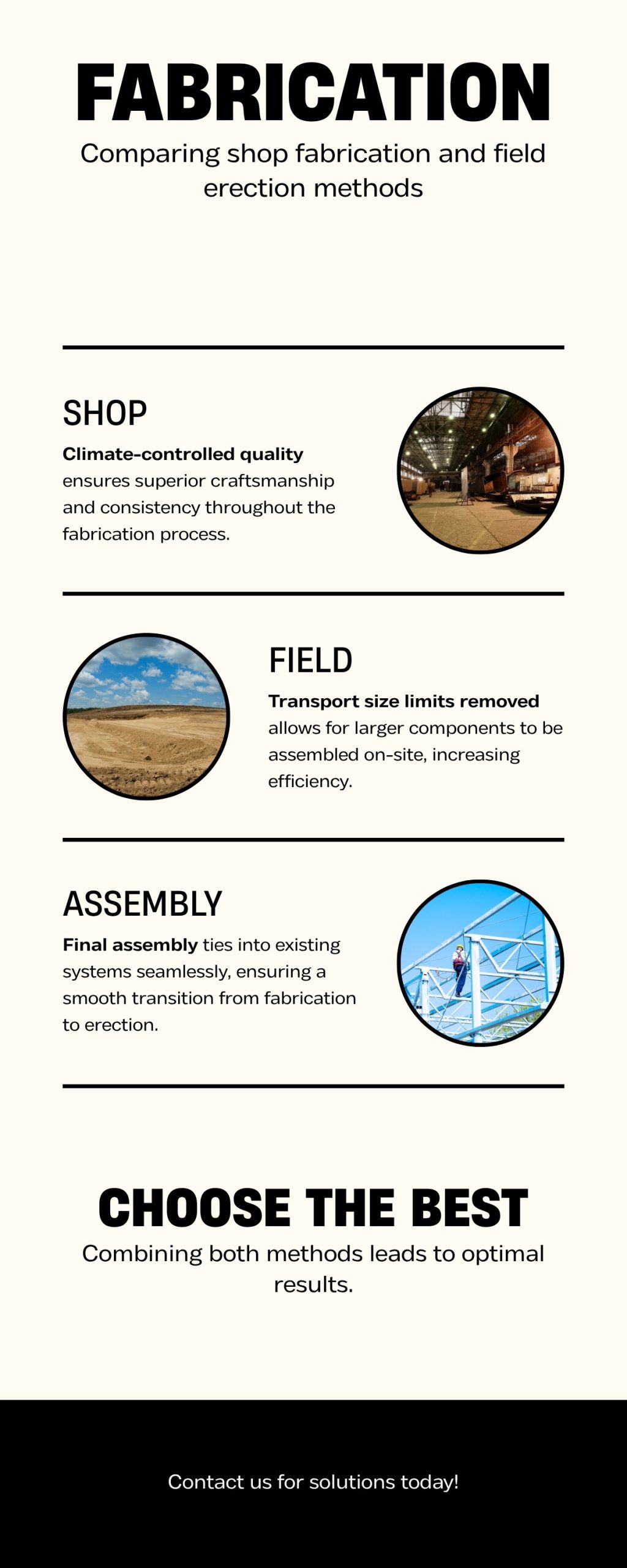
Neither one wins outright, and any fabricator who claims otherwise is selling something. Shop fabrication controls the environment; field erection controls the fit. Nearly every industrial project blends both, and the real planning question is where each weld, each coat of paint, and each bolt-up belongs.
Here’s the honest, qualitative version of the trade.
What the shop gives you. Weather control, first and always. Then quality documentation: welds made at fixed stations get inspected and recorded in an orderly sequence, which matters when an owner’s quality team asks for the paper trail two years later. And parallel workflows. While excavators are still moving dirt on site, the shop is already producing, so fabrication and sitework advance at the same time instead of in single file.
What the shop costs you. Transport sets the ceiling. Every assembly must ride a truck, clear bridges, and make the turns, so pieces get engineered around shipping envelopes and weights. Bigger modules mean fewer field welds but harder logistics. That’s a design conversation, not an afterthought.
What the field gives you. Reality. As-built conditions never perfectly match the model, and field crews make the final connections, closure welds, and fit-up adjustments that no shop drawing fully anticipates. Field erection also has no shipping limit: the piece is born where it lives.
What the field costs you. Weather exposure, stacked trades, congested laydown, and inspection performed wherever the weld happens to be, sometimes forty feet in the air in January.
The same logic runs even deeper in piping, where spool-by-spool decisions shape the whole weld map. We cover that in detail in our companion post on process piping shop fabrication vs field welding.
Why Does Shop Fabrication Matter So Much in Northeast Winters?
Because winter here doesn’t negotiate. Anyone who’s worked a February project along the I-90 corridor knows the drill: lake-effect snow, wind that shuts down crane picks, and steel cold enough to demand preheat before a field welder can strike an arc. Daylight runs short. Productivity follows it.
Coatings suffer most. Blast profiles, application temperatures, humidity limits, and cure times all have specification ranges that an upstate January simply refuses to provide. Push field coating into deep winter and you’re choosing between schedule slip and quality risk. Neither is a good buy.
Inside 700,000 square feet of enclosed, controlled shop space, none of that applies. Welders weld, blasters blast, painters hold their environmental ranges, and finished assemblies accumulate in the laydown yard while the site is still frozen. When the thaw opens the weather window, steel rolls out ready to set. We’ve built that rhythm into decades of Northeast work since 1982, and it’s why regional owners increasingly write shop fabrication into their execution plans instead of hoping for a mild winter.
Could you brute-force winter fieldwork with hoarding, heaters, and overtime? Sometimes. You’ll pay for it in money and morale, and the weld documentation still gets harder to keep clean.
How Fabrication Capacity De-Risks a Fast-Track Schedule
Fast-track work is where shop capacity stops being a nice-to-have. Private US data center construction reached a $50.7 billion seasonally adjusted annual rate in April 2026, up roughly 27% year over year and ahead of general office construction for the first time (US Census Bureau, via Data Center Knowledge, 2026). Owners behind that spending aren’t asking whether contractors can build. They’re asking whether contractors can build in parallel.
Shop fabrication is how you buy parallelism. While foundations cure, the shop produces pipe spools, steel, and skid frames. While one crew erects area A, the yard stages area B in delivery order. The schedule stops being a single chain of weather-exposed tasks and becomes several shorter chains running at once. In our experience, that structure protects a fast-track date better than any recovery plan written after the slip.
It also protects the scarcest resource on any mission-critical job: skilled people. Field hours from certified millwrights and pipe welders are precious, so the fewer hours they spend fighting weather and congestion, the more they spend setting and connecting equipment. That’s the core argument of our data center construction guide, and it’s why fabrication capacity keeps showing up in prequalification questionnaires.
For upstate New York specifically, the timing is hard to ignore. Semiconductor and data center investment is landing along the I-90 corridor, and we’ve mapped what that means for regional contractors in our post on the upstate NY semiconductor and data center corridor.
What Should You Look for in Steel and Pipe Fabrication Companies?
Floor space is the easy check. The harder questions separate fabricators that make parts from contractors that deliver projects. Here’s the short list we’d put to any bidder, ourselves included.
Certifications, by name. Certified welders and fabricators for the pressure and structural work, NACE-certified painters and blasters for coatings, licensed crane operators for the heavy handling. Ask for the paper, not the promise.
Blast and paint in-house. If fabricated steel leaves for a third-party coating shop, you’ve added a trucking leg, a schedule interface, and a finger-pointing seam to every load.
Real laydown. Sequenced storage is what lets a fabricator feed a jobsite just-in-time. Fifty-five acres of it is why Dansville can hold finished work until the field calls for it.
Owned equipment and self-performed field crews. A fabricator that also erects, as LMC does across structural, mechanical, and piping scopes, owns the shop-to-field handoff instead of arguing about it. Our overview of what industrial contractors do covers why self-perform matters across the board.
Documentation culture. Ask to see how weld records, material traceability, and coating reports are kept on a current job. The answer predicts your closeout package.
Frequently Asked Questions About Steel and Pipe Fabrication
What is steel fabrication?
Steel fabrication is the cutting, forming, welding, and assembly of raw steel into finished structural components: beams, trusses, pipe racks, platforms, gantries, and modules. It happens in a shop before erection. Field erection then installs those fabricated pieces on site. At LMC, both happen under one contract.
What’s the difference between fabrication and erection?
Fabrication builds the pieces; erection installs them. A bridge span gets fabricated indoors as welded steel assemblies, then erected in the field with cranes and bolted or welded connections. Splitting these between unrelated companies creates a handoff seam. Contractors that self-perform both keep responsibility in one place.
Why does shop fabrication beat field welding in winter?
Cold steel needs preheat, coatings need minimum application and cure temperatures, and snow and wind shut down crane picks and slow every field task. Inside a heated shop, none of that applies. Work fabricated indoors through January arrives site-ready the day conditions allow, which is why Northeast schedules lean on shop capacity.
Do pipe fabrication companies also handle structural steel?
Some do, most don’t. Many pipe shops spool pipe only, and many steel fabricators don’t weld pressure piping. LMC fabricates both at the Dansville campus, along with blast and coating, which lets one supplier feed a project’s structural, piping, and paint scopes in a coordinated sequence.
What does NACE-certified paint and blast mean?
NACE certification (now part of AMPP) covers industrial corrosion control: surface preparation, coating selection, application, and inspection to recognized standards. LMC employs NACE-certified painters and blasters who apply protective coating systems in controlled shop conditions, where specification ranges for temperature, humidity, and cure can actually be held.
How large is LMC’s fabrication facility, and where is it?
The campus sits at 9431 Foster Wheeler Road in Dansville, New York: 700,000+ square feet of covered fabrication space on 88 acres, with 55 acres of laydown and storage. It’s staffed from LMC’s 350+ skilled tradespeople and supported by 300+ pieces of company-owned equipment.
How do we get a fabrication quote from LMC?
Send your drawings, specs, and schedule through the contact page on lmcic.com, call (585) 335-3131, or email lmcinfo@lmcic.com. We’ll tell you plainly what fits the shop, what belongs in the field, and how the Dansville campus can carry your dates.
The Bottom Line on Big-Shop Fabrication
Steel fabrication at campus scale isn’t about square footage for its own sake. It’s about control: over weather, over weld quality and its paper trail, over coating conditions, and over a schedule that no longer waits single-file on site access. The trade-off is transport planning, and it’s a trade worth engineering deliberately on almost every fast-track industrial job.
That’s what 700,000+ square feet in Dansville buys an owner: automated fabrication and welding, NACE paint and blast under the same roof, 55 acres of sequenced laydown, and field crews from the same company to set what the shop built.
Ready to put shop capacity behind your schedule? Contact LMC Industrial Contractors or call (585) 335-3131 to scope your next steel, pipe, or coatings package.
