
Before LMC set its first bridge girder or bid its first data center mechanical package, it welded pipe. Lawrence Mehlenbacher founded the company in 1982 as a mechanical contractor specializing in process piping, and the About page still tells the story plainly: LMC “evolved from a mechanical contracting company specializing in process piping to a leading provider of comprehensive industrial and infrastructure services.”
Every capability added since, structural steel, millwright services, coatings, civil work, grew around that founding trade. This post covers what process piping actually is, which industries depend on it, and a decision owners rarely watch but always pay for: how much of the pipe gets welded in the shop versus stick-built in the field.
Key Takeaways
- Process piping has been LMC’s core trade since the company’s founding in 1982.
- Verified industries served: ethanol conversion, food & beverage, pharmaceutical, chemical processing, industrial facilities, and water treatment.
- Shop spooling puts welds in a controlled environment with consistent quality control and documentation.
- Field crews handle what no shop can: field-fit welds, tie-ins, and as-built conditions.
What Is Process Piping, Exactly?
Process piping is the network of pipe, fittings, valves, flanges, and supports that carries the materials a facility actually processes: chemicals, steam, fuel gas, food product, process water. It is not plumbing. LMC has self-performed this trade since 1982, longer than any other service on its mechanical roster.
The distinction matters more than it sounds. Plumbing brings potable water in and sanitary waste out. Comfort HVAC conditions air for people. Process piping serves production itself, and when it stops, the plant stops. That’s why industrial piping is built to recognized industrial piping codes, with qualified welding procedures and inspection requirements that commercial building trades rarely encounter.
A typical process piping scope includes:
- Pipe, fittings, valves, and flanges installed to the project’s line specifications
- Pipe supports, hangers, and rack runs
- Welding performed by certified welders and fabricators
- Examination, testing, and turnover documentation
In our experience, that last line separates industrial piping contractors from general mechanical shops. Every weld has a welder behind it and a paper trail beside it. Owners in regulated industries audit that trail, and a contractor’s documentation culture shows itself long before its field quality does.
Which Industries Rely on Process Piping Contractors?
LMC installs process piping across six industry groups: ethanol conversion facilities, food & beverage factories, pharmaceutical factories, chemical processing facilities, industrial facilities, and water treatment facilities. The product in the pipe changes. The fundamentals don’t: qualified welds, clean documentation, and schedules that respect a running plant.
Ethanol conversion and chemical processing plants run around the clock, so new piping usually ties into live systems during planned outage windows. Tie-in work on those sites is as much scheduling discipline as welding skill. Miss the window and the owner eats production downtime.
Food & beverage and pharmaceutical factories add hygiene to the equation. The pipe carries product people will eventually consume, so material selection, cleanliness, and finish quality carry extra weight, and the documentation expectations climb with them.
Water treatment plants and general industrial facilities round out the list: large-bore lines, pump and equipment connections, and utility piping, often for municipal or institutional owners with formal inspection cultures of their own.
Scoping a process piping package? LMC has self-performed piping and mechanical work since 1982. Contact us or call (585) 335-3131 to talk scope, spooling strategy, and schedule.
Shop Spooling vs Field Welding: How Does the Work Split?
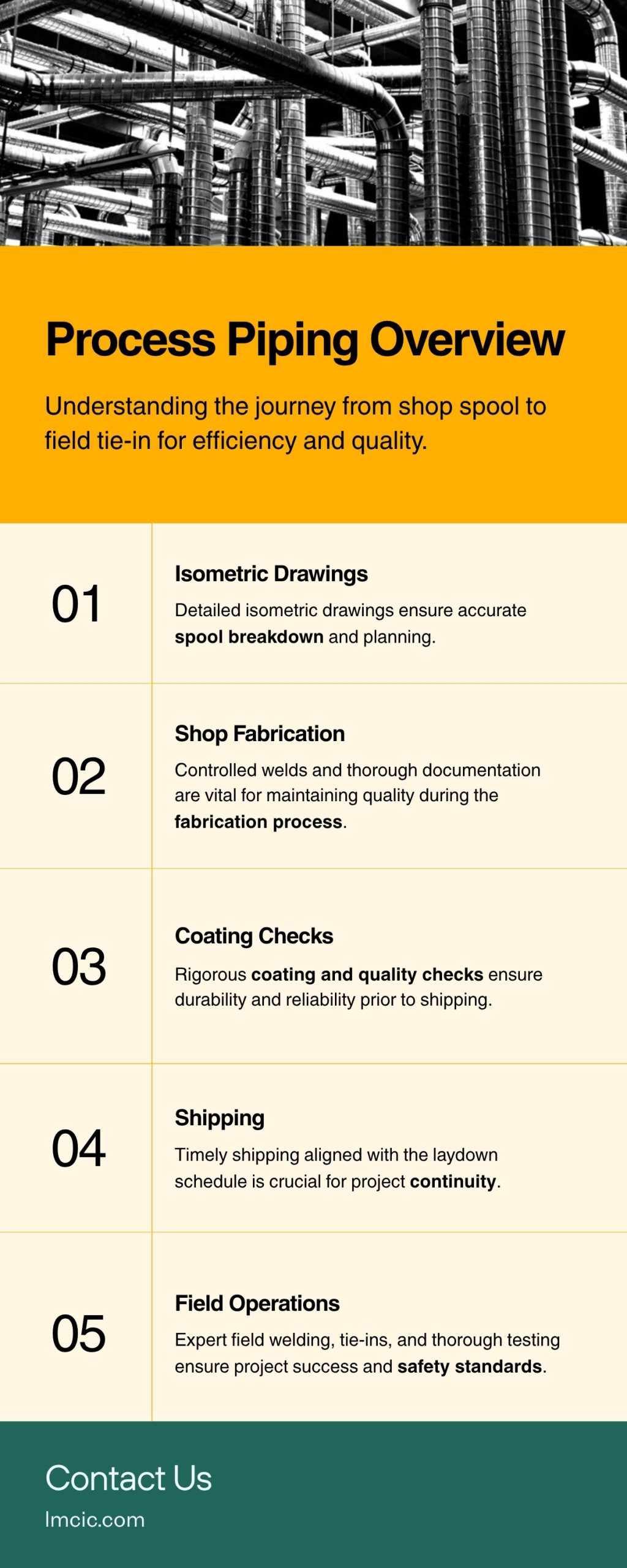
Shop spooling breaks piping isometric drawings into transportable welded assemblies called spools, fabricates them indoors, and trucks them to site. Field crews hang the spools and connect them with field welds and tie-ins. LMC spools pipe in a 700,000+ square foot covered fabrication facility in Dansville, NY. Nearly every project needs both halves.
Where you draw that line quietly shapes cost, quality, and schedule. Here’s how the trade-offs run.
What the Shop Does Better
A fabrication shop controls everything the field can’t. Welders work at fixed stations with material staged beside them, and the pipe rotates instead of the welder. Rolling a joint into the flat position is simply easier to weld well, and easier to weld consistently, than reaching around a fixed line overhead.
Quality control lives a few steps away instead of a truck ride away. Welds get examined and documented as the work happens, not reconstructed afterward. LMC’s Dansville shop runs automated fabrication and welding equipment, and NACE-certified painters and blasters can blast and coat spools before they ever see a trailer. We covered the facility itself in our tour of the 700,000 sq ft fabrication shop.
Then there’s the calendar. Shop spooling runs in parallel with sitework: while excavation and foundations advance, finished spools stack up in 55 acres of laydown, ready to ship. And a January storm rolling across the Finger Lakes doesn’t slow a welder standing indoors. In upstate New York, that alone can decide a schedule.
What Has to Happen in the Field
No shop drawing survives contact with an existing plant. Some welds must wait for reality: equipment nozzles land wherever the equipment finally sits, which is why precision equipment setting by certified millwrights and piping crews coordinate so closely. Tie-ins to existing systems demand field verification, because decades-old lines rarely match decades-old drawings.
That’s what field-fit welds are for. Fabricators leave deliberate allowances at tie-in points and equipment connections so field crews can measure, cut, and fit to as-built conditions. Field welders then work in position, vertical, overhead, tight access, often inside an operating facility. None of this is lesser work. Field welding is frequently the harder discipline, and it’s where a contractor’s experience shows.
Finding the Right Split
There’s no universal ratio, and we’d distrust anyone who quotes one. The split depends on line sizes, shipping routes, site access, whether the plant is live, and how brutal the schedule is. We’ve found that pushing the maximum sensible scope into the shop holds schedule best through Northeast winters, but over-spooling backfires when assemblies arrive without enough field tolerance to fit the real world.
Why Compressor Stations Prove Piping Capability
Natural gas compressor stations are some of the most piping-dense facilities a contractor can build, which is why LMC’s oil and gas portfolio doubles as its piping résumé. The portfolio speaks for itself: the Wantage NJ 325 Compressor Station, Perulack Compressor Station, 610 Compressor Station, Highland & Hancock Compressor Station, and the Portland Xpress and Westbrook Xpress projects.
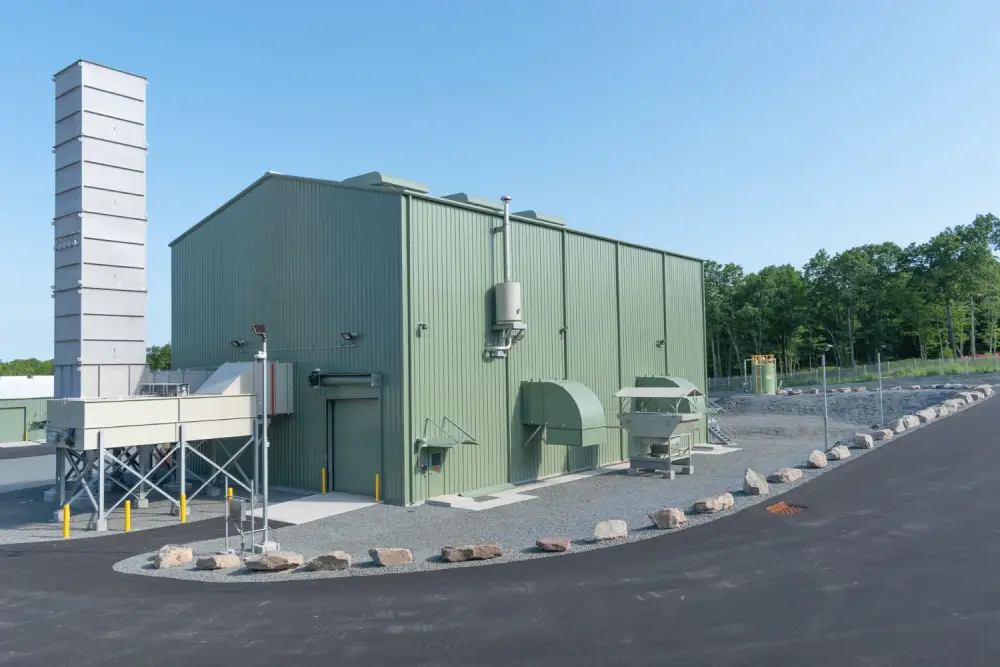
Look at what a station like Highland & Hancock actually requires. Welded gas piping snaking between compression equipment. Precision-set machinery that determines where every nozzle lands. Structural supports, protective coatings against the weather, and a schedule driven by pipeline commitments rather than contractor convenience. That combination, certified welding plus equipment setting plus coatings plus schedule discipline, is the whole process piping trade compressed onto one site.
Where Process Piping Meets Data Center Construction
The newest buyers of piping capability aren’t refineries. Private US data center construction reached a $50.7 billion seasonally adjusted annual rate in April 2026, passing general office construction for the first time (US Census Bureau, via Data Center Knowledge, 2026). Behind every rack sits mechanical infrastructure: cooling loops, fuel gas lines, and utility piping.
That’s why LMC describes itself as “a leading construction contractor in natural gas compressor stations, process piping, millwright services, precision equipment setting, industrial painting and coatings, and full-service facilities construction, which aligns naturally with the infrastructure demands of behind-the-meter power and mission-critical facilities.” The same Dansville shop that spools compressor station pipe spools chilled water and fuel gas lines for power generation and data center work.
We laid out the full mechanical picture in our data center construction guide, and the regional stakes, Micron, GlobalFoundries, the I-90 corridor, in our post on the upstate NY semiconductor and data center corridor. The short version: mission-critical owners are discovering what plant owners always knew. Piping contractors with their own shop capacity protect schedules.
What Should You Ask a Process Piping Contractor?
Four questions surface most of what matters: who performs the welding, how welds get documented, where fabrication happens, and what else the contractor self-performs. LMC’s answers rest on 350+ skilled tradespeople, certified welders and fabricators on staff, and a 700,000+ square foot shop backing every field crew.
Who holds the welding credentials? Ask whether welders are employees or brokered labor, and ask to see qualifications. We explained the self-perform versus broker distinction in what industrial contractors actually do.
How is quality documented? Weld records, examination results, and turnover packages should be a routine deliverable, not a special request. Documentation culture predicts field quality.
Where will the pipe be fabricated? Covered shop capacity is schedule insurance, especially north of the Mason-Dixon line. A contractor spooling indoors all winter delivers in early spring what a field-only crew is still welding into summer.
What travels with the pipe? Piping rarely arrives alone. Equipment setting, structural supports, and coatings ride the same schedule, and LMC self-performs all three, with 300+ pieces of owned equipment so cranes mobilize on the project’s timeline.
Frequently Asked Questions About Process Piping Contractors
What’s the difference between process piping and plumbing?
Plumbing handles potable water and sanitary drainage for building occupants. Process piping carries the materials a facility produces or consumes: chemicals, steam, fuel gas, food product, treated water. It’s installed to recognized industrial piping codes with qualified welding procedures, and it sits on the critical path of production, not comfort.
What is a pipe spool?
A spool is a prefabricated section of a piping system, typically pipe, fittings, and flanges welded together in a shop from isometric drawings, sized to survive trucking and rigging. Spools arrive at site ready to hang, so field crews spend their hours on fit-up and tie-ins instead of production welding.
Is shop fabrication better than field welding?
They’re complements, not rivals. The shop offers a controlled environment, in-position welding, immediate quality control, and immunity to weather. The field handles what no shop can predict: as-built dimensions, equipment connections, and tie-ins. Good piping contractors decide the split during planning, not after the schedule slips.
Can every weld be made in the shop?
No, and be wary of anyone who implies otherwise. Tie-ins to existing systems and connections to newly set equipment need field-fit welds, with allowances left deliberately so crews can measure and fit real as-built conditions before cutting pipe.
Which industries does LMC serve with process piping?
Six industry groups: ethanol conversion facilities, food & beverage factories, pharmaceutical factories, chemical processing facilities, industrial facilities, and water treatment facilities. That range traces straight back to 1982, when the company began as a mechanical contractor specializing in process piping.
Does compressor station piping experience transfer to data centers?
Directly. Compressor stations demand certified welding, precision equipment connections, coatings, and unforgiving schedules, the same package data center mechanical work requires for cooling loops and behind-the-meter fuel piping. The station portfolio is the proof at scale.
How do we get a process piping bid from LMC?
Send your scope outline, line list or isometrics if you have them, and target dates through the contact page, call (585) 335-3131, or email lmcinfo@lmcic.com. We’ll tell you plainly what we’d spool in Dansville, what we’d field-run, and how that split protects your schedule.
The Bottom Line on Shop vs Field Piping
Process piping isn’t a line item LMC added to a brochure. It’s the trade the company was founded on in 1982, and everything since, the 700,000+ square foot shop, the certified welders, the compressor station portfolio, the data center mechanical scope, grew out of it. The shop-versus-field question has no universal answer. It has a project-specific one, and contractors who own both halves of the workflow can give it honestly.
Winters here don’t negotiate. Owners who lock in shop capacity early keep welding through them.
Ready to talk piping scope? Contact LMC Industrial Contractors or call (585) 335-3131 to discuss spooling, field installation, and tie-in strategy for your next project.
