
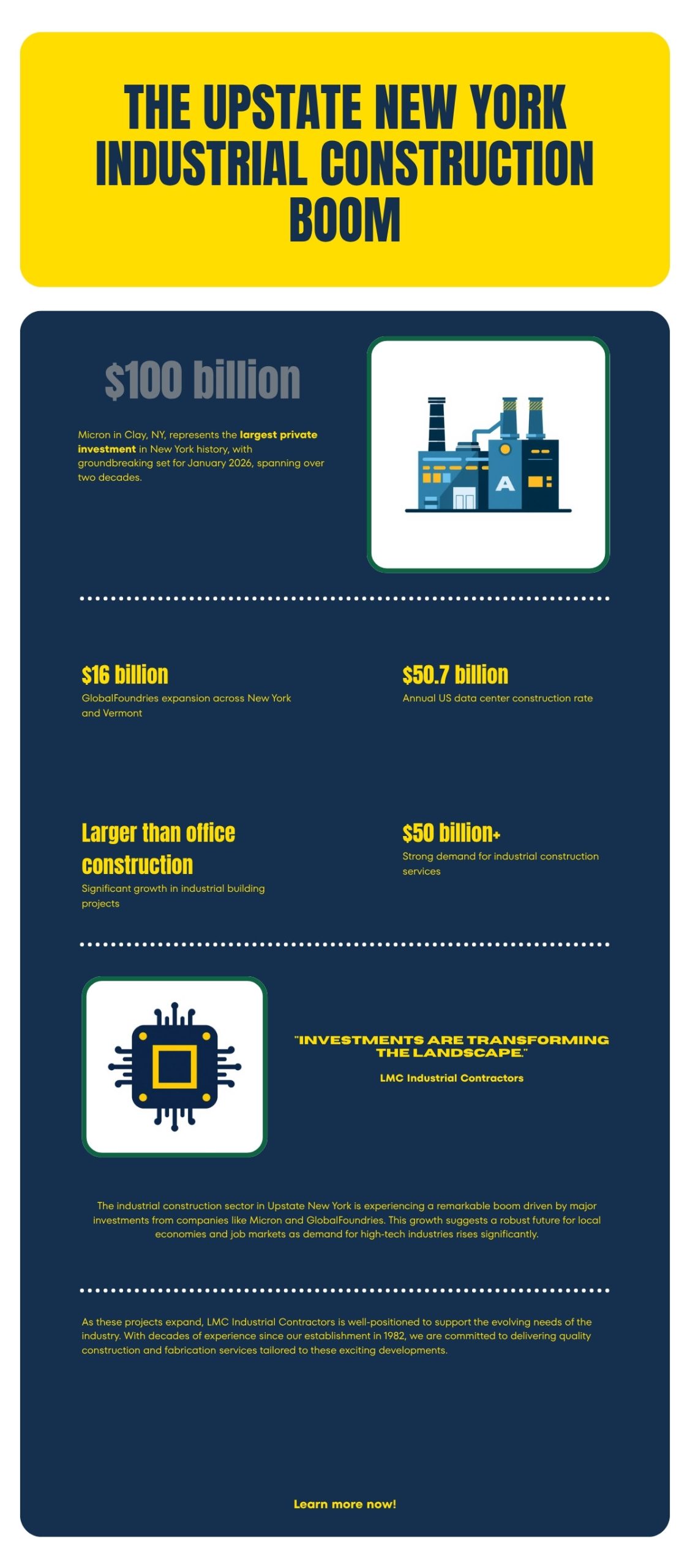
Data center construction just overtook the American office building. In April 2026, private US data center construction reached a $50.7 billion seasonally adjusted annual rate, up roughly 27% from $39.8 billion a year earlier and ahead of general office construction ($43.8 billion) for the first time (US Census Bureau, via Data Center Knowledge, 2026).
That shift changes who builds. Owners racing to add capacity aren’t just hiring electrical contractors and shell builders. They need mechanical crews, certified millwrights, process piping fabricators, and coatings specialists: the same trades that have kept power generation and gas infrastructure running for decades.
We’ve been fielding those calls. This guide covers what the boom looks like from the mechanical side, why millwrights are the scarce trade, and why upstate New York is suddenly on the mission-critical map.
Key Takeaways
- US data center construction hit a $50.7B annual pace in April 2026, passing office construction for the first time (US Census Bureau, via Data Center Knowledge).
- These facilities need mechanical, millwright, piping, structural, and coatings scopes, not just electrical.
- Millwrights are the bottleneck trade: only about 41,300 work in the entire US.
- Micron’s Clay, NY groundbreaking is pulling mission-critical construction into upstate New York.
What’s Driving the Data Center Construction Boom?
Compute demand is producing the fastest electricity growth in a generation, and construction spending is chasing it. US electricity use is forecast to grow 1% in 2026 and 3% in 2027, the strongest four-year growth period since 2000, driven primarily by large computing centers (US Energy Information Administration, 2026).
The load numbers behind that forecast are stark. Data centers consumed roughly 4.4% of all US electricity in 2023, about 176 terawatt-hours, up from 58 TWh in 2014. By 2028, that share is projected to reach somewhere between 6.7% and 12% of national consumption, or 325 to 580 TWh (DOE / Lawrence Berkeley National Laboratory, 2024).
Every one of those terawatt-hours needs a building, cooling, backup power, and fuel or grid infrastructure behind it. So where does the money land on site? Concrete, steel, piping, and equipment. The server racks arrive last. The trades that set chillers, weld pipe, and erect structure arrive first, and they’re the ones in shortest supply.
Planning a mission-critical or behind-the-meter project in the Northeast? LMC self-performs mechanical, millwright, piping, structural, and coatings scopes from Dansville, NY. Contact us or call (585) 335-3131 to talk scope and schedule.
What Mechanical and Millwright Scopes Does a Data Center Need?
A data center is a mechanical building wrapped around an electrical load. Before a rack ever powers on, crews must set and align chillers, air handlers, pumps, generators, and skidded equipment to precision tolerances, install the piping that moves heat and fuel, erect structural steel, and coat all of it to last. LMC fields 350+ skilled tradespeople across those scopes.
Precision Equipment Setting and Alignment
This is millwright work, and it’s the heart of the mission-critical scope. Rotating and skidded equipment that runs continuously for years cannot tolerate sloppy installation. Certified millwrights handle rigging, setting, leveling, grouting, and precision alignment as part of LMC’s mechanical services, supported by licensed crane operators and 300+ pieces of owned equipment. No waiting on rental yards.
Process Piping Fabrication and Installation
Cooling loops, fuel gas lines, and utility piping carry the thermal load of the entire facility. Certified welders and pipe fabricators build these systems to code, and shop fabrication lets spools arrive on site ready to hang. In our experience, that single move protects fast-track schedules better than any recovery plan written after the fact.
Structural, Civil, and General Building Scopes
Someone has to put steel in the air and keep the balance of plant moving. LMC self-performs structural steel erection, shop-based structural fabrication, and general construction services for equipment buildings, pipe racks, platforms, and enclosures, which keeps trade coordination inside one contract instead of five.
Industrial Painting and Protective Coatings
Coatings are cheap insurance on assets designed to run for decades. LMC’s NACE-certified painters and blasters apply protective coating systems in the shop and in the field, which matters in Northeast climates where freeze-thaw cycles and road salt punish bare steel.
Where Electrical Fits: The Honest Answer
Electrical is not part of LMC’s core self-perform work, and we’d rather say so plainly than pretend otherwise. We partner with highly skilled, experienced electrical companies and bring the mechanical and construction scopes alongside them, plus “a strong millwright team for precision equipment setting and a disciplined project controls group to help manage complex, fast-track schedules.” Owner’s reps tend to appreciate a contractor that knows its lane.
Why Millwrights Are the Bottleneck Trade
The entire United States employs about 41,300 millwrights, with only 3,600 projected job openings (2024 to 2034 projections) (O*NET / Bureau of Labor Statistics, 2024). That’s the whole national bench for the trade every data center, semiconductor fab, and power plant depends on for equipment setting.
Now set that scarcity against the broader labor market. In the AGC’s 2025 workforce survey, 92% of construction firms trying to hire reported difficulty finding qualified workers, 88% had open craft positions, and 45% reported project delays caused by workforce shortages (Associated General Contractors of America, 2025). Nearly half of firms are already late because they can’t staff the work. Millwrights sit at the sharpest point of that squeeze.
Here’s what the national coverage misses: the millwrights best prepared for mission-critical work aren’t coming out of commercial construction at all. They’re coming out of energy infrastructure. A crew that has aligned rotating equipment at a natural gas compressor station has already worked to tighter tolerances, under stricter quality documentation, than most building trades ever encounter. Contractors who kept those crews busy year-round through energy cycles now hold the scarcest resource in the data center boom: a retained, certified millwright bench.
Behind-the-Meter Power: Why Gas Infrastructure Contractors Fit
Data centers increasingly bring their own generation, and the grid data shows why. In EIA’s high data-center-demand scenario, US natural gas generation rises 123 billion kWh between 2025 and 2027, versus 29 billion kWh in the baseline case, while ERCOT load is forecast to grow roughly 10% per year over that stretch (EIA Today in Energy, 2026).
Behind-the-meter generation means building power production on the customer’s side of the utility meter: gas-fired units, fuel infrastructure, and balance-of-plant systems dedicated to one facility. Who already builds exactly that? Natural gas infrastructure contractors. For LMC, behind-the-meter power “is a natural extension of what we already do every day.” The scope list reads like a compressor station bid package:
- Natural gas piping installation and process piping fabrication
- Facility and balance-of-plant construction support
- Precision equipment setting and alignment
- Structural, mechanical, and general construction scopes
- Industrial painting and protective coatings
- Project coordination in schedule-driven environments
That’s not theoretical crossover. LMC’s oil and gas portfolio includes the Wantage NJ 325 Compressor Station, Perulack Compressor Station, 610 Compressor Station, Highland & Hancock Compressor Station, and the Portland Xpress and Westbrook Xpress projects. Every one demanded the same disciplines a behind-the-meter power installation demands: certified pipe welding, precision equipment setting, structural work, coatings, and schedule-driven coordination.
The Upstate New York Opportunity
Micron broke ground in Clay, New York in January 2026 on what the Governor’s office calls the largest private investment in New York State history, expected to generate tens of thousands of construction jobs over 20 years (Office of the Governor of New York, 2026). The plan: up to $100 billion over 20-plus years, a $20 billion first phase, up to four fabs with 2.4 million square feet of cleanroom, roughly 9,000 Micron jobs, and 40,000+ community jobs (Micron, 2026).
It isn’t alone. GlobalFoundries announced a $16 billion expansion across its New York and Vermont facilities in June 2025, over $13 billion for fab capacity and $3 billion for R&D, citing AI-driven chip demand (GlobalFoundries, 2025).
Why does semiconductor money matter to data center construction? Because fabs and data centers are the same species of building. Cleanroom-adjacent mechanical systems, mile after mile of process piping, precision-set equipment, unforgiving schedules. When investment at this scale lands along the I-90 corridor, it pulls suppliers, power projects, and mission-critical siting decisions into the same region, and it strains the same regional trade pool. Owners planning upstate builds will compete for millwrights and pipe welders with the biggest private project in state history.
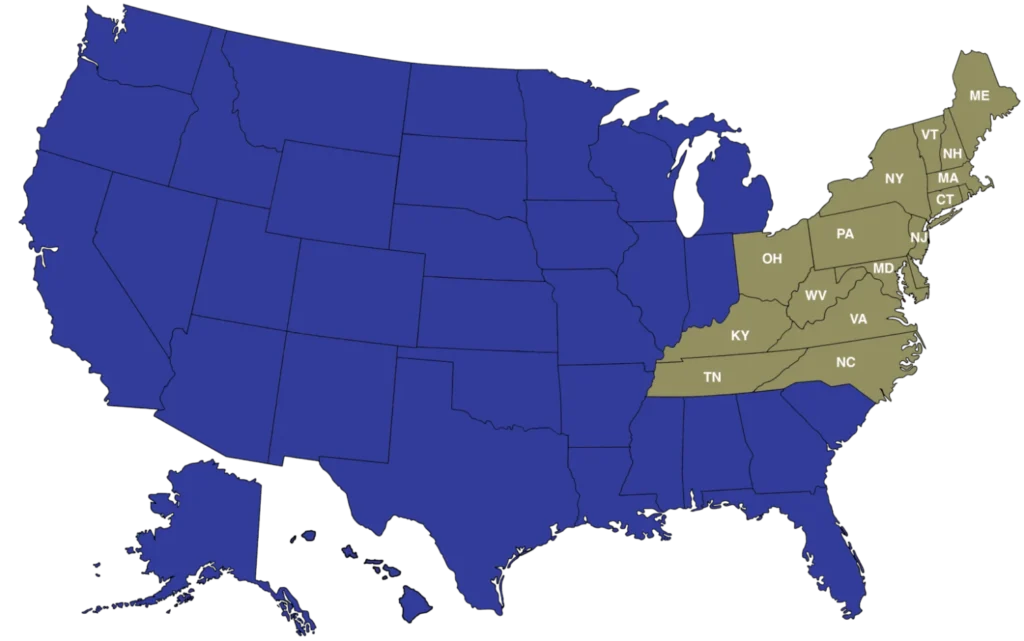
That competition rewards contractors already rooted here. LMC has built from Dansville, NY since Lawrence Mehlenbacher founded the company in 1982: an 88-acre site with 55 acres of laydown and a 700,000+ square foot covered fabrication facility, within a short haul of the I-90 corridor projects reshaping the region.
Covered shop capacity is not a brochure line in this climate. Northeast winters are real. We’ve found that work fabricated indoors through January and February holds schedule while field-welded scope waits on weather windows. Modules, spools, and steel roll out the door ready to set the day site conditions allow.
How Should Owners Prequalify a Mechanical and Millwright Partner?
Prequalification is mostly a staffing question now. Owners screening data center contractors for mechanical and millwright packages are really screening labor benches: with 45% of construction firms reporting project delays caused by workforce shortages (AGC, 2025), the contractor’s retained craft bench matters more than its marketing. Here’s what we’d ask any bidder, including ourselves.
Verify certifications by name. Ask for certified welders and fabricators, certified millwrights and carpenters, NACE-certified painters and blasters, licensed crane operators, and licensed HVAC service technicians. Paper qualifications predict field quality.
Ask what’s self-performed versus brokered. Subcontracted scope adds markup and coordination risk. LMC self-performs mechanical, millwright, piping, structural, civil, and coatings work, and partners for electrical. Any contractor should be able to draw that line for you just as clearly.
Inspect fabrication capacity. Can the bidder fabricate pipe spools, structural steel, and modules indoors, at scale, through the winter? Shop throughput is schedule insurance.
Check owned equipment. A fleet of 300+ owned pieces means cranes and iron mobilize on the contractor’s timeline, not a rental counter’s.
Probe project controls. Fast-track mission-critical work lives or dies on scheduling, cost tracking, and documentation discipline. Ask how the last schedule-driven project was actually managed, then call the reference.
Frequently Asked Questions About Data Center Construction
What does a millwright do on a data center project?
Millwrights rig, set, level, grout, and precision-align mechanical equipment: chillers, pumps, air handlers, generators, and skidded systems. Their tolerances determine whether equipment runs reliably for decades. With only about 41,300 millwrights employed nationwide (O*NET/BLS, 2024), they’re frequently the scarcest trade on a mission-critical site.
Does LMC self-perform electrical work on data centers?
No, and we say so up front. Electrical is not part of LMC’s core self-perform work. We partner with highly skilled, experienced electrical companies while self-performing the mechanical, millwright, process piping, structural, civil, and coatings scopes, backed by a project controls group built for fast-track schedules.
What is behind-the-meter power generation?
Behind-the-meter power is generation built on the customer’s side of the utility meter, dedicated to one facility instead of the grid. For data centers, that typically means gas-fired generation with fuel piping and balance-of-plant construction, the same scopes contractors build at natural gas compressor stations.
How much US electricity do data centers actually use?
Data centers consumed about 4.4% of US electricity in 2023, roughly 176 TWh, up from 58 TWh in 2014. DOE and Lawrence Berkeley National Laboratory project that share reaching 6.7% to 12% by 2028, or 325 to 580 TWh (DOE/LBNL, 2024).
Why does off-site fabrication matter for data center schedules?
Shop fabrication moves welding and assembly indoors, where weather, congestion, and stacked trades can’t slow it. That matters in the Northeast, where winter can stall field welding for weeks. LMC runs a 700,000+ square foot covered fabrication facility in Dansville, NY so spools, steel, and modules arrive site-ready.
Is upstate New York really becoming a mission-critical construction market?
Yes. Micron broke ground in Clay, NY in January 2026 on the largest private investment in New York State history, up to $100 billion over 20-plus years (governor.ny.gov, 2026), and GlobalFoundries announced a $16 billion New York and Vermont expansion in 2025. That investment pulls suppliers, power projects, and data center siting into the region.
How do we get LMC pricing for a data center or power project?
Reach out through the contact page on lmcic.com, call (585) 335-3131, or email lmcinfo@lmcic.com with your scope outline and schedule. We’ll tell you honestly which scopes we self-perform, which we’d team on, and whether our fabrication and field capacity fits your dates.
The Bottom Line for Owners and Owner’s Reps
Data center construction now outspends office construction, electricity demand is climbing at a pace unseen since 2000, and the trades that make these facilities run, millwrights above all, are in structurally short supply. The contractors positioned to deliver are the ones who built energy infrastructure through the lean years and kept certified crews, shop capacity, and project controls intact.
That’s the bench LMC brings: mechanical, millwright, process piping, structural, civil, and coatings scopes, self-performed from a 700,000+ square foot fabrication facility in Dansville, NY, with trusted electrical partners for the rest.
Ready to talk about your project? Contact LMC Industrial Contractors or call (585) 335-3131 to discuss mechanical, millwright, and fabrication scope for your next mission-critical build.
