
Somebody has to set the machine. Every chiller, generator, conveyor drive, and process skid in American industry gets rigged, leveled, grouted, and aligned by a millwright, and the entire United States employs about 41,300 of them (O*NET / Bureau of Labor Statistics, 2024).
That small trade now carries the biggest industrial building wave in decades. Data centers, semiconductor fabs, and behind-the-meter power plants all depend on precision-set equipment, a demand story we cover from the owner’s side in our data center construction mechanical and millwright guide.
This post digs into the trade itself. What millwright services include, what precision equipment setting involves step by step, where the work shows up, and why a certified, retained millwright bench has become the scarcest asset on an industrial bid list.
Key Takeaways
- Millwright services cover machinery installation, precision equipment setting and alignment, rigging coordination, conveyor systems, and equipment maintenance or relocation.
- US millwright employment is just 41,300, with 3,600 projected job openings (2024–2034 projections) (O*NET/BLS, 2024).
- Data centers and other critical facilities rely on millwrights to set chillers, generators, pumps, and skidded systems.
- LMC fields certified millwrights inside a 350+ tradesperson self-perform workforce based in Dansville, NY.
What Are Millwright Services?
Millwright services cover the installation, precision setting, alignment, maintenance, and relocation of industrial machinery. A millwright takes equipment from the truck bed to run-ready: rigging it into position, leveling and grouting it, and aligning rotating components to tolerance. It’s also among the scarcest skilled trades in construction.
In practice, the scope breaks into five buckets:
- Machinery installation. Receiving, rigging, setting, and commissioning support for production and process equipment.
- Precision equipment setting and alignment. Leveling, grouting, and aligning machinery so rotating and connected components run true.
- Rigging coordination. Planning and executing lifts, from open-yard crane picks to confined machinery moves inside operating plants.
- Conveyor and material handling systems. Installing and aligning conveyors, drives, and the structures that carry product through a facility.
- Maintenance and relocation. Realigning, rebuilding, modifying, and moving equipment across a plant or across the state.
The trade is often confused with general mechanical labor. It shouldn’t be. A pipefitter joins systems and an ironworker erects structure, but the millwright owns the machine itself, along with the fine measurements that decide whether it survives its duty cycle. If you’re still sorting out which trades belong under one contract, our post on what industrial contractors do draws those lines in detail.
Need certified millwrights for an installation, alignment, or relocation? LMC self-performs millwright services across the Northeast from Dansville, NY. Contact us or call (585) 335-3131.
What Does Precision Equipment Setting Actually Involve?
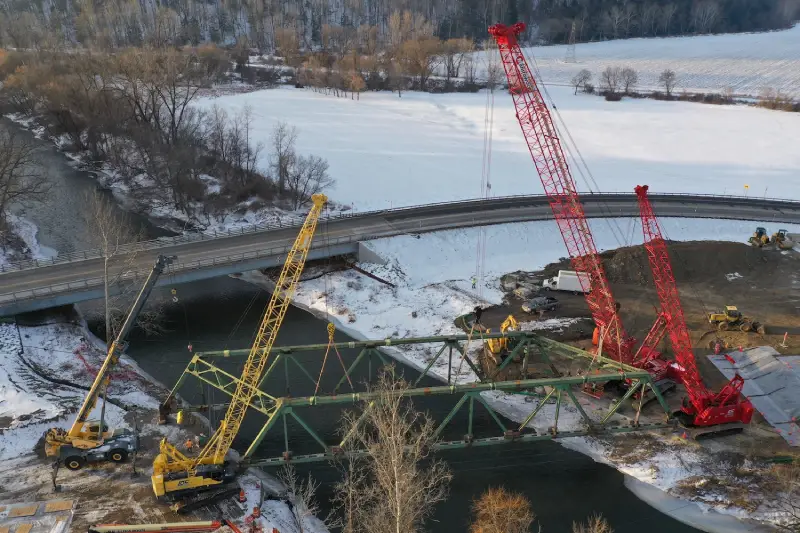
Precision equipment setting is a sequence, not a single lift. The machine is rigged onto its foundation, leveled to its design plane, grouted so it stays put, and aligned so every connected component runs true. LMC millwrights perform each step in-house as part of our mechanical services, backed by licensed crane operators and 300+ pieces of owned equipment.
Rigging and Setting
The lift plan comes first. Crews verify weights, rigging points, and travel paths before anything leaves the trailer, because a machine damaged on day one never fully forgives you. Owned cranes and industrial telehandlers mean the iron shows up on our schedule, not a rental counter’s.
Leveling and Grouting
Why grout a machine that’s already level? Because level today means nothing if the baseplate rocks, drifts, or vibrates loose next year. Millwrights level the equipment to its design plane, then grout the baseplate so foundation and machine behave as one mass through years of thermal and dynamic load.
Precision Alignment
Alignment is where the trade earns its reputation. Using laser alignment tools and dial indicators, millwrights bring shafts, couplings, and drives into tolerance so rotating equipment doesn’t chew through bearings and seals. Misalignment rarely fails a machine on startup. It fails it eighteen months later, in the middle of a production run.
Where Millwrights Fit in Data Center and Critical-Systems Work
Private US data center construction reached a $50.7 billion seasonally adjusted annual rate in April 2026, passing general office construction for the first time (US Census Bureau, via Data Center Knowledge, 2026). Nearly every mechanical dollar in those buildings eventually rests on equipment a millwright set: chillers, air handlers, pumps, generators, and skidded fuel systems.
Setting quality becomes reliability in these buildings. Cooling and power equipment runs continuously, and an alignment shortcut taken under a fast-track schedule surfaces later as vibration, seal failure, or the downtime the facility was engineered to never allow. That’s why LMC pairs “a strong millwright team for precision equipment setting” with “a disciplined project controls group” on power generation and data center work. Precision and schedule have to survive together.
We covered the owner’s-side economics, from electricity demand to prequalification checklists, in the data center construction pillar guide. The trade-side story is simpler. Crews that aligned rotating equipment at natural gas compressor stations arrived at mission-critical work already fluent in tight tolerances and heavy documentation. The buildings changed. The discipline didn’t.
Behind-the-meter power adds a second wave of setting work: gas-fired generation, fuel skids, and balance-of-plant equipment installed on the customer’s side of the meter. For a contractor built on compressor stations, that scope reads like a familiar bid package.
Machinery Installation, Conveyors, and Material Handling
Millwright work extends well past mission-critical rooms. The same trade installs production machinery, sets and aligns conveyor and material handling systems, and modifies or relocates equipment that has outgrown its footprint. LMC has self-performed that range across upstate New York and beyond since 1982, with certified welders and fabricators alongside the millwright crews.
Conveyors punish sloppy installation more visibly than almost any system. Alignment has to hold across the full run: drives, pulleys, idlers, and transfer points all cooperating, or belts wander, spill product, and eat themselves. Setting each section true, then truing the system end to end, is patient work. It’s also cheaper than replacing belting every quarter.
The work turns up in odd places, too. Our crews performed salt car modifications for American Rock Salt: cutting, welding, and refitting heavy rail equipment to the customer’s spec. Machinery installation, structural modification, and millwright precision tend to travel together on jobs like that.
Relocations and outage work reward shop support. Guards, frames, skids, and replacement steel fabricated indoors at our 700,000+ square foot fabrication facility arrive ready to bolt in, which matters when a January outage window in upstate New York is measured in days. We take you inside that shop in our fabrication facility tour.
Why Are Millwrights So Hard to Find?
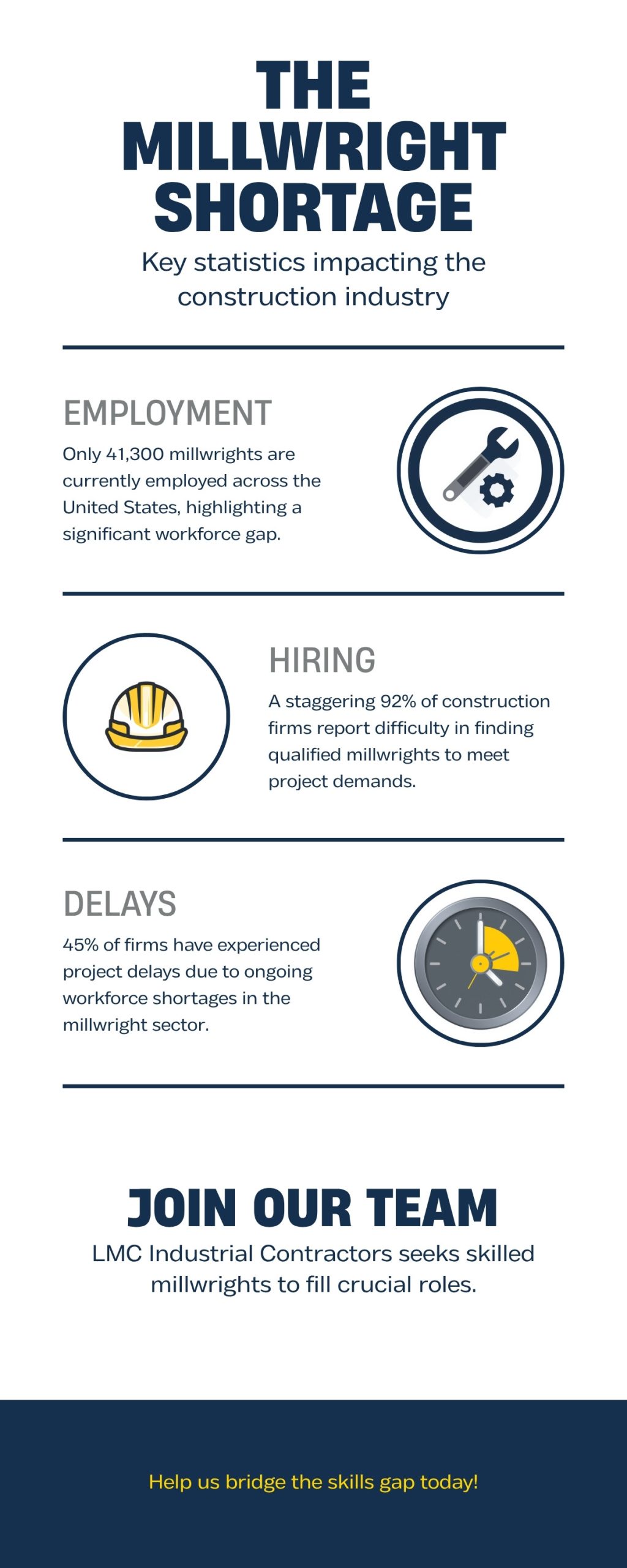
The scarcity is structural. US millwright employment is just 41,300 (2024), with 3,600 projected job openings (2024–2034 projections) (O*NET 49-9044 / Bureau of Labor Statistics, 2024). A trade that small cannot staff a national buildout of data centers, fabs, and power projects simultaneously, no matter what wages do.
The broader labor market offers no relief. In the AGC’s 2025 workforce survey, 92% of construction firms trying to hire reported difficulty finding qualified workers, 88% had open craft positions, and 45% reported project delays caused by workforce shortages (Associated General Contractors of America, 2025). Millwrights sit at the sharpest point of that squeeze, because the trade takes years of apprenticeship to produce and the bench was thin before the boom started.
So where do qualified crews come from? Mostly from contractors who kept them. In our experience, millwrights stay where the work stays: firms that ran steady energy-infrastructure scope through slow cycles held onto certified crews that commercial contractors let go. That’s why owners’ reps have started asking about millwright headcount at prequalification, right next to bonding capacity. If a bidder can’t name its bench, its schedule is a hope.
The LMC Millwright Bench: 350+ Trades Behind Every Setting Crew
LMC fields certified millwrights inside a 350+ tradesperson self-perform workforce, so an equipment-setting crew never works alone. Certified welders and fabricators, NACE painters and blasters, licensed crane operators, certified carpenters, and licensed HVAC service technicians surround the millwright scope, with 300+ pieces of owned equipment mobilizing from Dansville, NY.
The bench has history behind it. Lawrence Mehlenbacher founded LMC in 1982 as a mechanical contractor specializing in process piping, and the company grew from that founding trade into comprehensive industrial and infrastructure services. Compressor station projects like Wantage NJ 325, Highland & Hancock, and Portland Xpress kept setting-and-alignment crews sharp on schedule-driven, documentation-heavy work.
That history shapes how we run fast-track jobs today. A disciplined project controls group manages complex schedules, shop fabrication protects winter productivity, and the millwright crews arrive with the riggers, welders, and painters they’ll need already inside the same contract. One bench. One point of accountability.
Frequently Asked Questions About Millwright Services
What does a millwright do?
A millwright installs, sets, levels, grouts, aligns, maintains, and relocates industrial machinery. The trade covers everything from rigging a chiller onto its pad to bringing a conveyor drive into tolerance. It’s also rare: only about 41,300 millwrights work in the entire United States (O*NET/BLS, 2024).
What’s the difference between a millwright and a rigger?
Riggers move loads; millwrights make machines run. Rigging is often part of millwright services, and millwrights plan and execute lifts, but the trade’s defining skill is what happens after the pick: the leveling, grouting, and precision alignment that determine how long the equipment lasts.
What equipment do millwrights set in a data center?
Chillers and cooling plant equipment, air handlers, pumps and piping skids, backup generators, and fuel or utility equipment skids. Each gets rigged, set, leveled, grouted, and aligned. Our data center construction guide covers how those scopes fit into the larger mechanical package.
Do millwright services include conveyor systems?
Yes. Conveyor and material handling installation is core millwright territory: setting sections, aligning drives, pulleys, and idlers, and truing the system end to end so belts track properly. Millwrights also modify, extend, and relocate existing conveyor systems during outages and plant expansions.
Why is there a millwright shortage?
The trade is small and slow to grow. US millwright employment is just 41,300, with 3,600 projected job openings (2024–2034 projections) (O*NET/BLS, 2024), while 45% of construction firms already report project delays from workforce shortages (AGC, 2025). Demand from data centers, fabs, and power projects is rising faster than apprenticeships can produce journeymen.
Does LMC self-perform millwright work or subcontract it?
LMC self-performs it. Certified millwrights are part of our 350+ tradesperson workforce, working alongside our own welders, crane operators, and painters with 300+ pieces of owned equipment. Electrical is the scope we intentionally partner out; millwright and mechanical work stays in-house.
How do I hire LMC’s millwright team?
Call (585) 335-3131, email lmcinfo@lmcic.com, or use the contact page on lmcic.com with your equipment list, site location, and schedule window. We’ll respond with an honest read on scope, crew availability, and whether shop fabrication in Dansville can shorten your field duration.
Set It Once, Set It Right
Millwright services decide how industrial equipment lives: installed to tolerance and grouted to stay, or destined for the premature bearing failures nobody can quite explain. With about 41,300 millwrights nationwide and demand compounding from data centers to salt plants, the certified crew you can actually book has become the real differentiator.
LMC brings that crew, inside a 350+ tradesperson bench with owned cranes, a 700,000+ square foot fabrication shop, and four decades of setting equipment through upstate New York winters.
Ready to put millwrights on your schedule? Contact LMC Industrial Contractors or call (585) 335-3131 to scope your machinery installation, alignment, or relocation project.
