
In January 2026, Micron broke ground in Clay, New York on what the Governor’s office calls the largest private investment in New York State history, a project expected to generate tens of thousands of construction jobs over 20 years (Office of the Governor of New York, 2026).
That single groundbreaking rearranged the industrial construction map of the Northeast. Add GlobalFoundries’ expansion in the Capital Region and Vermont and a national data center boom that just overtook office construction, and upstate New York suddenly looks like a corridor, not a collection of one-off projects.
This post lays out the corridor thesis, what these builds actually need from regional industrial contractors, and why the real constraint won’t be money. It’ll be people. We covered the mechanical side of the boom in our data center construction guide; this is the regional picture.
Key Takeaways
- Micron plans up to $100 billion over 20+ years in Clay, NY, the largest private investment in state history (Micron; governor.ny.gov).
- GlobalFoundries announced a $16 billion New York and Vermont expansion in June 2025.
- Nationally, data center construction passed office construction for the first time in April 2026.
- Workforce, not capital, is the binding constraint: 45% of firms already report shortage-driven delays.
What Just Landed in Upstate New York?
The largest private investment in New York State history. Micron plans up to $100 billion over 20-plus years in Clay, with a $20 billion first phase, up to four fabs, and 2.4 million square feet of cleanroom (Micron, 2026). Ground broke in Onondaga County in January 2026 (governor.ny.gov, 2026).
The employment math explains why the state treats this as a generational project. Micron’s fact sheet projects roughly 9,000 direct Micron jobs plus 40,000-plus community jobs, and the Governor’s office expects tens of thousands of construction jobs across the two-decade build. Construction at that scale doesn’t stay inside one fence line. It pulls suppliers, utilities, and subcontract packages across the whole region.
And Micron isn’t the only chipmaker writing checks in New York. GlobalFoundries announced a $16 billion expansion across its New York and Vermont facilities in June 2025, with more than $13 billion aimed at fab capacity and $3 billion at R&D, citing AI-driven chip demand (GlobalFoundries, 2025).
One honest note before we go further, because it matters. LMC has no announced contract with Micron or GlobalFoundries, and nothing in this post should be read as claiming one. What we’re describing is the wave itself: what investment on this scale does to a regional construction market, and what owners sourcing industrial contractors in New York should be thinking about right now.
Planning an industrial, fab-adjacent, or data center project in the Northeast? LMC self-performs mechanical, millwright, piping, structural, civil, and coatings scopes from Dansville, NY. Contact us or call (585) 335-3131.
The National Backdrop: Data Centers Pass the Office Building
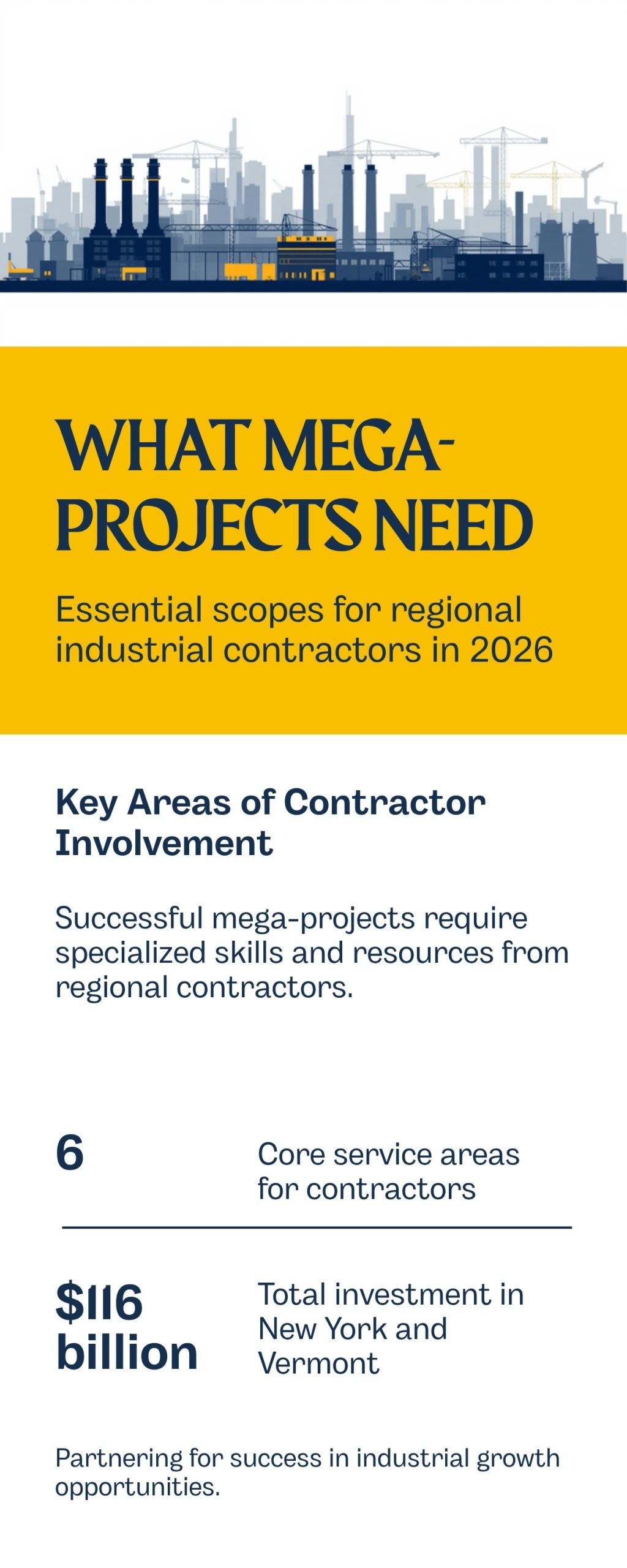
The corridor isn’t forming in a vacuum. Private US data center construction hit a $50.7 billion seasonally adjusted annual rate in April 2026, up roughly 27% from $39.8 billion a year earlier, and passed general office construction ($43.8 billion) for the first time (US Census Bureau, via Data Center Knowledge, 2026).
Demand is chasing electricity, and electricity growth is historic. US electricity use is forecast to grow 1% in 2026 and 3% in 2027, the strongest four-year growth period since 2000, driven primarily by large computing centers (US Energy Information Administration, 2026).
Why does a chip fab matter to data center siting? Because fabs and data centers are close cousins on a construction drawing. Both are mission-critical mechanical buildings: precision-set equipment, dense process piping, heavy structural packages, and unforgiving schedules. When a region proves it can permit, power, and staff a fab campus, it becomes credible for data center and behind-the-meter power projects too. Investment attracts investment. That’s the corridor thesis in one sentence.
What Do These Projects Need From Regional Industrial Contractors?
Five things, mostly. Fab-adjacent and data center work generates site infrastructure, structural steel packages, process piping, modular skids, and precision equipment setting, scope after scope, for years. LMC self-performs all five with 350+ skilled tradespeople and 300+ pieces of owned equipment, the same bench that has built natural gas and industrial facilities across the Northeast since 1982.
The direct fab tool install is a specialized world. But the ring of work around these campuses, and around every data center that follows them, looks exactly like traditional heavy industrial construction. Here’s how it breaks down.
Site Infrastructure and Civil Work
Before steel goes vertical, somebody moves earth, places concrete, and builds the roads, pads, and utility corridors a campus runs on. LMC’s civil construction crews handle excavation, foundations, and sitework with owned dozers, excavators, and haul trucks, so mobilization doesn’t wait on a rental yard.
Structural Steel Packages
Pipe racks, equipment platforms, support structures, and building frames make up a steady stream of bid packages on any large industrial campus. LMC self-performs structural steel erection in the field and structural fabrication in the shop, which keeps detailing, fabrication, and erection under one roofline of accountability.
Process Piping and Utility Systems
Process piping has been LMC’s founding trade since 1982, and these facilities consume it by the mile: cooling loops, fuel gas, compressed air, water treatment, and utility distribution. Shop-spooled piping arrives site-ready, a discipline we broke down in our post on shop fabrication versus field welding for process piping.
Modular Skids and Shop-Built Assemblies
Fast-track schedules reward anything built indoors and shipped ready to set. Skidded equipment packages, pre-assembled racks, and modular units cut field hours on congested sites, and congested is exactly what a multi-year mega-campus becomes. In our experience, the contractors who can modularize are the ones who protect the schedule when winter or trade-stacking hits.
Precision Equipment Setting
Chillers, pumps, air handlers, generators, and skidded systems all need rigging, setting, leveling, grouting, and precision alignment. That’s certified millwright work, delivered through LMC’s mechanical services team and detailed in our guide to millwright services and precision equipment setting. Tolerances set on day one decide reliability for decades.
Why Does Regional Fabrication Capacity Matter Now?
Because the field season here is short and the schedules aren’t. LMC operates a 700,000+ square foot covered fabrication facility on 88 acres in Dansville, NY, with 55 acres of storage and laydown, automated fabrication and welding, and advanced technology and equipment. Indoor capacity at that scale turns a Northeast winter from a schedule risk into ordinary production time.
Anyone who has managed a January weld window in central New York knows the problem. Field welding waits on weather. Shop welding doesn’t. Spools, steel, and modular assemblies fabricated indoors through the cold months roll out the door the day site conditions allow, a case we made in detail in our tour of the 700,000 square foot fabrication facility.
Geography does the rest. Dansville sits a short haul from the I-90 corridor that links the Clay campus, the GlobalFoundries region, and the utility and supplier projects forming around both. Trucking fabricated steel and spooled pipe a few hours up the Thruway is a very different logistics problem than shipping it in from out of state, especially when laydown space near a mega-site is scarce and every delivery window is contested.
The Real Constraint: Workforce
Money is committed; people are not. In the AGC’s 2025 workforce survey, 92% of construction firms trying to hire reported difficulty finding qualified workers, and 45% reported project delays caused by workforce shortages (Associated General Contractors of America, 2025). Nearly half the industry is already late for lack of hands.
Now drop tens of thousands of construction jobs into one upstate county over 20 years. Every crane operator, pipe welder, and ironworker within driving distance of Clay has a new bidder for their time. Owners planning any industrial or data center project in New York will compete for craft labor with the largest private project in state history, whether their site is in Syracuse or three hours down the Thruway.
The squeeze is sharpest in the trade these facilities depend on most. US millwright employment is just 41,300 (2024), with 3,600 projected job openings (2024 to 2034 projections) (O*NET / Bureau of Labor Statistics, 2024). That’s the entire national bench for precision equipment setting, and the corridor will lean on it hard.
What should owners do about it? Prequalify for retained labor, not promised labor. A contractor with certified millwrights, welders, and crane operators already on payroll, and shop capacity to keep them productive year-round, is holding the scarcest asset in this market. We published a full prequalification checklist for industrial contractors if you want the long version.
Frequently Asked Questions About the Upstate NY Corridor
What is the upstate New York semiconductor and data center corridor?
It’s the concentration of announced chip and mission-critical investment along the I-90 spine: Micron’s up to $100 billion campus in Clay, GlobalFoundries’ $16 billion New York and Vermont expansion, and the power, supplier, and data center projects that scale of investment tends to attract (Micron, 2026; GlobalFoundries, 2025).
Is LMC working on the Micron or GlobalFoundries projects?
No. LMC has no announced contract with Micron or GlobalFoundries, and we won’t imply otherwise. Our point is regional readiness: the wave of fab-adjacent, utility, and data center work forming around these investments needs exactly the mechanical, structural, piping, and millwright scopes LMC has self-performed across the Northeast since 1982.
How big is the Micron investment in Clay, NY?
Micron plans up to $100 billion over 20-plus years, starting with a $20 billion first phase, up to four fabs, and 2.4 million square feet of cleanroom, with roughly 9,000 Micron jobs and 40,000+ community jobs projected (Micron, 2026). Ground broke in January 2026.
Why does semiconductor fab construction matter to data center owners?
Fabs and data centers demand the same construction DNA: precision equipment setting, process piping, structural steel, and schedule-driven coordination. Nationally, data center construction reached a $50.7 billion annual rate in April 2026 and passed office construction for the first time (US Census Bureau, via Data Center Knowledge, 2026). A region proven on fabs is credible for data centers.
What scopes can a regional industrial contractor self-perform on fab-adjacent work?
Site infrastructure and civil work, structural steel fabrication and erection, process piping fabrication and installation, modular skid assembly, precision equipment setting, and industrial coatings. LMC self-performs all of these with certified welders and fabricators, certified millwrights, NACE painters and blasters, and licensed crane operators, and partners with experienced electrical companies for electrical scope.
How will the labor shortage affect New York project schedules?
Expect competition. With 92% of hiring firms already struggling to find qualified workers and 45% reporting shortage-driven delays (AGC, 2025), a 20-year mega-project tightens the regional craft pool further. Contractors with retained crews and indoor fabrication capacity carry less of that risk.
How do we start a conversation with LMC?
Send a scope outline and target schedule through the contact page on lmcic.com, call (585) 335-3131, or email lmcinfo@lmcic.com. We’ll tell you plainly which scopes we self-perform, where we’d team, and whether our Dansville fabrication and field capacity fits your dates.
The Bottom Line for Owners Sourcing in New York
Upstate New York now hosts the largest private investment in state history, a second multi-billion dollar chip expansion, and a national data center boom that just outgrew the office building. The capital is committed. The buildings will be mechanical-heavy, piping-dense, and millwright-dependent, and the regional labor pool is already stretched.
That combination favors owners who lock in regional capacity early: contractors with retained certified crews, owned equipment, covered fabrication space for the winter months, and a short truck route to the I-90 corridor. LMC has been building that capacity in Dansville since 1982. No claims about who wins which contract, just a regional bench that’s ready for the work this corridor is creating.
Sourcing industrial contractors for a New York project? Contact LMC Industrial Contractors or call (585) 335-3131 to talk mechanical, structural, piping, and fabrication scope.
