
Picking an industrial contractor used to be a pricing exercise. Now it’s a staffing audit. In the AGC’s 2025 workforce survey, 92% of construction firms trying to hire reported difficulty finding qualified workers, and 45% reported project delays caused by workforce shortages (Associated General Contractors of America, 2025). The low bid means nothing if the crew behind it doesn’t exist.
This guide covers what industrial contractors actually do, the difference between self-perform and broker models, the trades and certifications owners should demand by name, why owned equipment matters, and how to prequalify a bidder before your schedule depends on them. We build this work every day from Dansville, NY, so we’ll show you where the risk hides.
Key Takeaways
- Industrial contractors build and maintain process facilities: piping, equipment setting, structural steel, coatings, and civil work, not offices or retail.
- Self-perform contractors staff your project with their own payroll crews; brokers subcontract scope and stack markup and coordination risk.
- 92% of hiring construction firms report difficulty finding qualified workers (AGC, 2025), so prequalify the labor bench, not the brochure.
- Demand named certifications, owned equipment, and covered fabrication capacity before shortlisting anyone.
What Do Industrial Contractors Actually Do?
Industrial contractors build, expand, and maintain the facilities that make, move, and process things: manufacturing plants, gas compressor stations, food and beverage factories, water treatment plants, and power installations. Where a commercial general contractor delivers a building, an industrial contractor delivers a working production system, with the piping, equipment, and structure all set to tolerance.
That distinction shapes every scope on the bid. A typical industrial package includes process piping fabrication and installation, mechanical work and precision equipment setting, structural steel erection, industrial painting and protective coatings, civil and sitework, and general construction of the buildings around it all. Get one of those trades wrong and the plant doesn’t run right, no matter how good the roof looks.
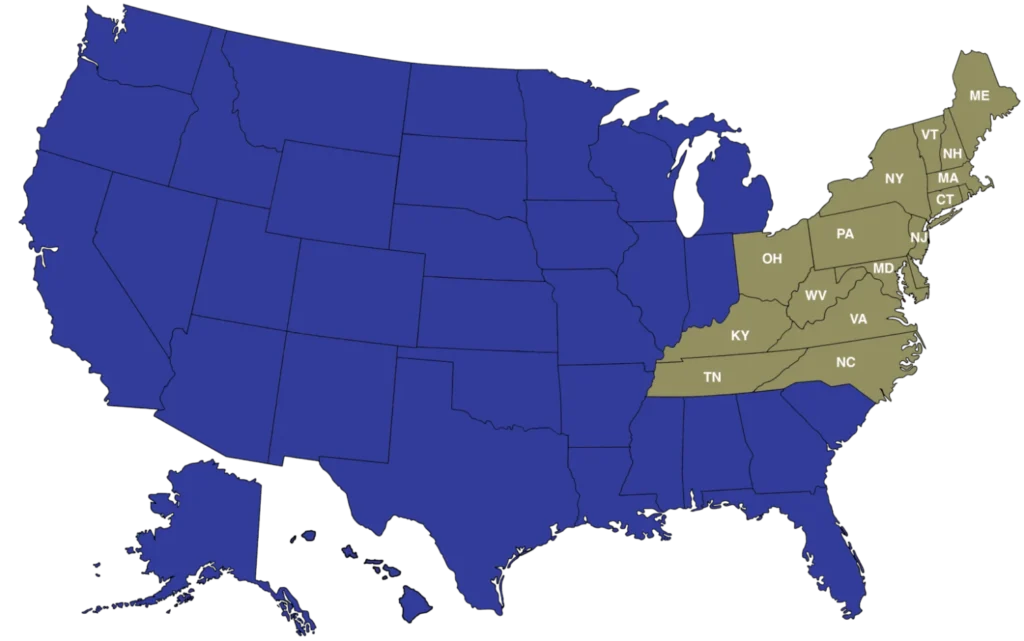
LMC has lived that evolution firsthand. Lawrence Mehlenbacher founded the company in 1982 as a mechanical contractor specializing in process piping, and it has since grown into a full industrial and infrastructure services provider serving oil and gas, manufacturing, food and beverage, pharmaceutical, chemical processing, and water treatment clients across the Northeast.
Scoping an industrial project in the Northeast? LMC self-performs mechanical, millwright, piping, structural, civil, and coatings scopes from Dansville, NY. Contact us or call (585) 335-3131 to talk through your bid package.
Self-Perform or Broker: Which Model Should You Hire?
A self-perform industrial contractor puts its own payroll craftspeople on your site. A broker wins the contract, then shops your scope to subcontractors. Both models can finish a project. Only one of them controls the labor that determines whether it finishes on time, and in a market where 88% of hiring firms have open craft positions (AGC, 2025), that control is the whole game.
Think about what brokering actually means right now. Your general contractor is competing for the same scarce subcontractors as every other GC in the region, then adding a management markup on whatever crews it manages to secure. Each subcontract boundary adds a coordination seam. Schedule slips get negotiated between companies instead of resolved at the morning huddle.
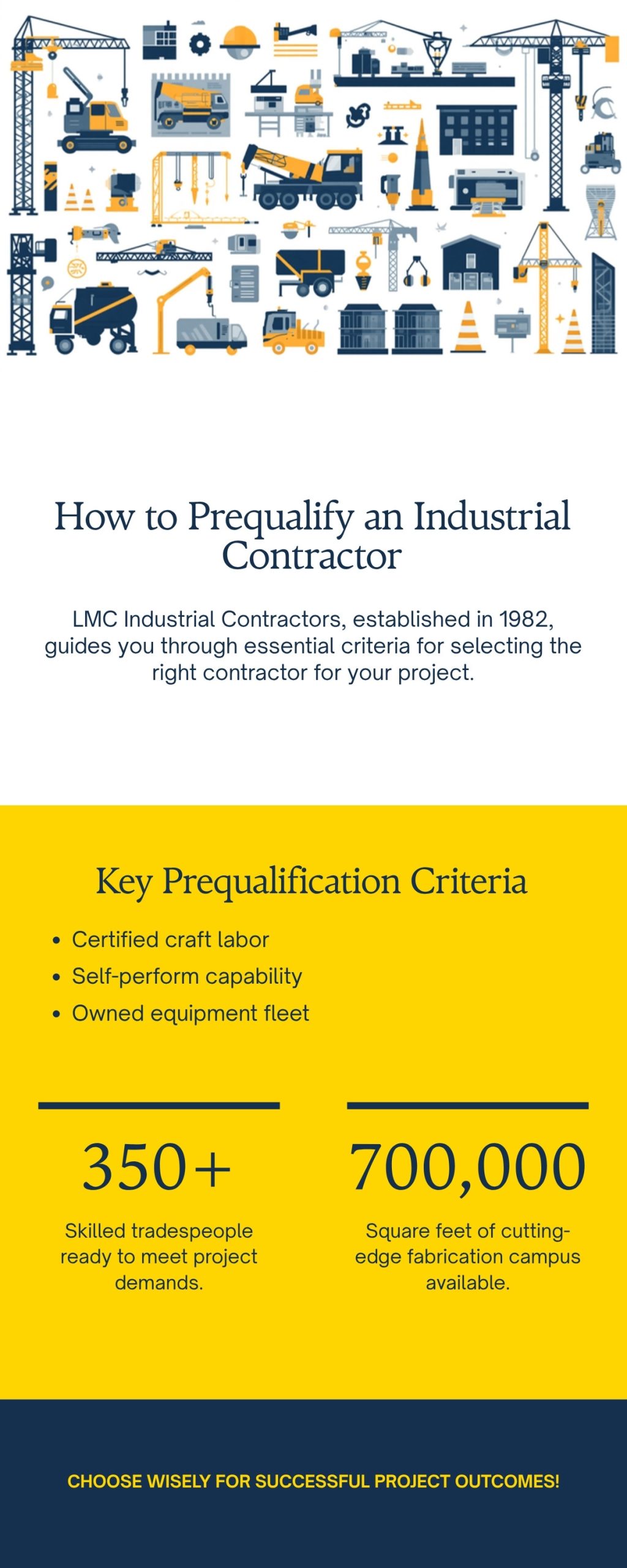
Self-perform flips that. The contractor’s welders, millwrights, ironworkers, and operators already share one safety program, one quality system, and one scheduler. LMC fields 350+ skilled tradespeople on its own payroll, which means the crew that fabricates your pipe in the shop answers to the same project manager as the crew that hangs it in the field.
One honest caveat: no contractor self-performs everything, and anyone who claims to deserves skepticism. Electrical is not part of LMC’s core self-perform work, so we partner with highly skilled, experienced electrical companies and say so up front. The right question for any bidder isn’t “do you subcontract?” It’s “exactly which scopes, and to whom?”
The Trades and Certifications Owners Should Demand
Certifications are the fastest way to separate an industrial contractor from a commercial GC wearing a hard hat. Ask every bidder to name the certified trades on its payroll, not in its subcontractor database. Paper qualifications predict field quality, and in this labor market they also prove the bench is real.
Here’s the list we’d hold any industrial bidder to, because it’s the one LMC staffs:
- Certified welders and fabricators. Process piping and structural work live or die on weld quality and the documentation behind it. Certification without a paper trail is half an answer.
- NACE-certified painters and blasters. Protective coatings are cheap insurance on steel that faces freeze-thaw cycles and road salt for decades. Certification governs surface prep, not just paint.
- Licensed crane operators. Heavy picks around live process equipment are no place for a rented operator meeting the crew for the first time.
- Certified millwrights and carpenters. Millwrights rig, set, level, grout, and align rotating and skidded equipment to precision tolerances. They’re also the scarcest trade on the list: the entire United States employs about 41,300 millwrights, with only 3,600 projected job openings (2024 to 2034 projections) (O*NET / Bureau of Labor Statistics, 2024). We cover what millwright services involve in its own guide.
- Licensed HVAC service technicians. Industrial facilities run on mechanical systems that need commissioning and service by licensed hands, not just installation.
Notice what that list implies. A contractor holding certified crews across all five trades has invested years in recruiting, training, and retaining them through market cycles. That’s precisely the investment a workforce shortage makes impossible to fake.
Owned Equipment or the Rental Counter: Why It Matters
An owned fleet means iron mobilizes on the contractor’s schedule instead of a rental yard’s availability. LMC maintains 300+ pieces of owned equipment: rough terrain and crawler cranes, excavators, dozers, industrial telehandlers, loaders, and haul trucks, staged on an 88-acre Dansville site with 55 acres of storage and laydown.
Why should an owner care whose name is on the crane? Three reasons show up on schedules. First, availability: when a weather window opens in a Northeast January, an owned crane rolls that morning, while a rented one joins a regional queue. Second, condition: contractors maintain what they own because their own crews depend on it. Third, cost transparency: owned equipment rates don’t swing with regional rental demand every time a megaproject mobilizes along the I-90 corridor.
Owned facilities compound the advantage. LMC pairs its fleet with a 700,000+ square foot covered fabrication facility, so pipe spools, structural steel, and modules get built indoors through the winter and roll out ready to set. We take you inside that facility in another post in this series.
How Do You Prequalify an Industrial Contractor?
Prequalify the bench, the fleet, and the systems, in that order. Price tells you what a contractor hopes the project costs. Prequalification tells you whether the contractor can actually build it. Here’s the six-point screen we’d apply to any industrial bidder, including ourselves.
1. Verify certifications by name. Certified welders and fabricators, certified millwrights and carpenters, NACE painters and blasters, licensed crane operators, licensed HVAC technicians. Ask for counts on payroll today.
2. Draw the self-perform line in writing. Which scopes stay in-house and which get brokered? Watch how quickly the bidder answers. A disciplined contractor knows its lane cold.
3. Inspect the fleet. Owned cranes and iron, maintained in-house, mobilize on your schedule. Ask for the equipment list and where it’s staged.
4. Tour the fabrication shop. Covered capacity is schedule insurance in the Northeast. Can the bidder spool pipe and fabricate steel indoors through February?
5. Audit safety and quality systems. Request the EMR history, the written safety program, and sample weld documentation from a recent job. Systems that exist on paper only will show it.
6. Call the references yourself. Ask specifically about schedule-driven work: how the last fast-track project was staffed, tracked, and recovered when something slipped. Then decide.
The Workforce Reality Behind Every Bid
Every prequalification question above traces back to one national problem: the industry cannot hire fast enough. According to the AGC’s 2025 Workforce Survey, 92% of construction firms trying to hire report difficulty finding qualified workers, 88% have open craft positions, and 45% report project delays caused directly by workforce shortages (Associated General Contractors of America, 2025).
Sit with that middle number. Nearly nine in ten firms have craft positions they cannot fill, right as data center and semiconductor construction pulls unprecedented demand into the Northeast. When a bidder promises you forty craftspeople in Q1, the honest follow-up is: employed by whom, today?
This is why the self-perform question has become the prequalification question. Contractors that retained certified crews through lean energy cycles now hold the scarcest asset in industrial construction: a proven, employed workforce. In our experience, owners who verify the bench before award spend far less time managing delay claims after it.
The regional angle matters too. Upstate New York’s industrial trade pool is deep but finite, and megaprojects along the I-90 corridor will draw from it for years. A contractor rooted in the region for four decades, as LMC has been since 1982, recruits from communities where its people already live rather than importing traveling crews at premium rates.
Frequently Asked Questions About Industrial Contractors
What is the difference between an industrial contractor and a general contractor?
A general contractor delivers buildings: offices, retail, schools. An industrial contractor delivers working production facilities, which demands trade depth a building GC doesn’t carry: certified pipe welding, precision millwright equipment setting, structural steel, protective coatings, and heavy rigging, usually performed with the contractor’s own crews and equipment.
What does “self-perform” mean in construction?
Self-perform means the contractor executes scope with craftspeople on its own payroll instead of subcontracting it. That keeps quality, safety, and scheduling under one management system and removes subcontractor markup. LMC self-performs mechanical, millwright, piping, structural, civil, and coatings work with 350+ skilled tradespeople, and partners with experienced electrical firms for electrical scope.
What certifications should an industrial contractor’s crews hold?
At minimum: certified welders and fabricators, certified millwrights and carpenters, NACE-certified painters and blasters, licensed crane operators, and licensed HVAC service technicians. Ask for the counts on payroll rather than accepting a general claim, since 88% of construction firms report open craft positions (AGC, 2025).
Why are millwrights so hard to find?
The trade is simply small. Only about 41,300 millwrights work in the entire United States, with 3,600 projected job openings (2024 to 2034 projections) (O*NET/BLS, 2024). Every plant, fab, and data center needs them for precision equipment setting, so contractors with retained millwright crews carry a genuine scheduling advantage.
What industries do industrial contractors serve?
LMC’s process piping heritage spans ethanol conversion facilities, food and beverage factories, pharmaceutical factories, chemical processing facilities, general industrial facilities, and water treatment facilities, plus natural gas infrastructure and power generation. Most industrial contractors specialize; ask for portfolio projects in your specific industry before shortlisting.
Does owning equipment really change project outcomes?
Yes, in three measurable ways: mobilization speed, equipment condition, and rate stability. An owned fleet rolls when the schedule says so instead of waiting on regional rental availability. LMC stages 300+ owned pieces, including rough terrain and crawler cranes, excavators, dozers, and telehandlers, at its Dansville, NY yard.
How do we start a conversation with LMC about a project?
Send a scope outline and target schedule through the contact page on lmcic.com, call (585) 335-3131, or email lmcinfo@lmcic.com. We’ll tell you plainly which scopes we self-perform, which we’d team on, and whether our fabrication and field capacity fits your dates.
The Bottom Line for Owners
Industrial contractors turn drawings into running facilities, and the good ones do it with their own certified people, their own iron, and covered fabrication capacity that shrugs off a Northeast winter. In a market where 92% of hiring firms report difficulty finding qualified workers, prequalification is no longer paperwork. It’s the difference between a schedule and a wish.
Screen every bidder against the six-point checklist: named certifications, a written self-perform line, an owned fleet, shop capacity, safety and quality systems, and references from schedule-driven work. Then verify all of it.
Ready to prequalify LMC for your bid list? Contact LMC Industrial Contractors or call (585) 335-3131. We’ve self-performed industrial work from Dansville, NY since 1982, and we’ll show you the bench, the shop, and the fleet behind every number in our proposal.
